
Caught: Corporation Doing Good

We are members of Truckers Against Trafficking (TAT), and this months newsletter featured UPS, unfortunately I could not find the link on the TAT website.

No alt text provided for this image

When a corporation does something really fantastic, all too often no one knows. I am sharing from the TAT newsletter (the italics are mine):

UPS has been named the winner of the 2021 TAT Champion Award in the Organization Category.

Kendis Paris, executive director of Truckers Against Trafficking (TAT), presented the award to Lou Rivieccio, UPS Corporate Transportation president, and Nikki Clifton, president of UPS Social Impact and The UPS Foundation, at a luncheon at the American Trucking Associations Management Conference and Exhibition Oct. 25 in Nashville, Tennessee.

The fight against the injustice of human trafficking is the work of thousands of dedicated and committed people taking place on continents and in countries around the world. Without the support, commitment and actions of the organizations, associations and state agency partners TAT works with, the gains made in the fight against human trafficking in the United States would take a huge leap backward. Each year, therefore, TAT recognizes and honors the outstanding creative, innovative, generous and dedicated efforts of specific partners, whose actions have significantly helped to engage more members of the industries TAT works with, as well as the efforts of more agencies and organizations within their state and the nation, in the fight to end the crime of human trafficking.

 UPS began its partnership with TAT in 2016. But, in addition to its work with TAT, which includes being a TAT sponsor at the highest – North Star — level, training more than 100,000 of their drivers, donating over 40 hauls for TAT’s mobile museum to events across the nation, allowing employees to be involved in numerous capacities with TAT on company time to spread awareness of human trafficking and the fight against it and serving on TAT’s Board of Directors since 2012, UPS also uses its influence through the trucking industry to encourage other companies to become TAT trained.

 “When we say that UPS is a ‘north star’ partner of TAT, no exaggeration is implied,” explained Paris. “They truly help to guide our work, by marshaling their resources on behalf of counter-trafficking initiatives, providing thought leadership, and supporting their drivers’ changemaking volunteerism. In doing so, they serve as a social-good exemplar to others in private industry, and we’re thrilled to name them our 2021 TAT Champion Award winners!”

 UPS has adopted an enterprise-wide anti-trafficking-in-persons policy, which strictly prohibits the use of any UPS assets or resources for any purpose that would enable the trafficking of persons. They partner with the DHS Blue Campaign and teamed up with Wellspring, a Georgia-based survivor’s advocacy program, to provide employment opportunities to survivors of human trafficking.

 UPS is also leveraging the power of corporate philanthropy to invest in organizations like the United Way Worldwide’s Center on Human Trafficking and Slavery and the Leadership Conference on Civil and Human Rights. That partnership employs a comprehensive and ground-breaking approach which convenes community leaders – including relief and human service agencies, medical providers, local government, employers, advocates, citizens and more – around the singular issue of fighting local human trafficking, in many cases, for the first time. Through this collaboration, they’re identifying needs and gaps at the community level, including housing, services, training and policy.

 Additionally, UPS employees have donated more than $5 million toward the Anti-Human Traffick Impact Fund through United Way Center on Human Trafficking and Slavery.

 In many public forums and presentations, UPS leadership use the opportunities they’re given to educate others on what they can do to join the fight. A TED Talk given by Clifton, detailing three ways businesses can fight human trafficking and personalize their efforts through their own “special sauce,” has now been seen by more than a million people.

Clifton shared, “Our work with TAT aligns with UPS’s purpose to move our world forward on delivering what matters. We are honored to accept this award and are proud to say that UPS drivers are part of the everyday heroes keeping communities safe by identifying and reporting red flags of human trafficking networks.”

______________________________________________________

Thank you UPS and thank everybody who sees something and says something. Lives have value not measured in dollars; but in joy, hope and the fulfillment of dreams. From their contributions to their family and friends, neighborhood and community.

Blood Money vs. Living Wage+

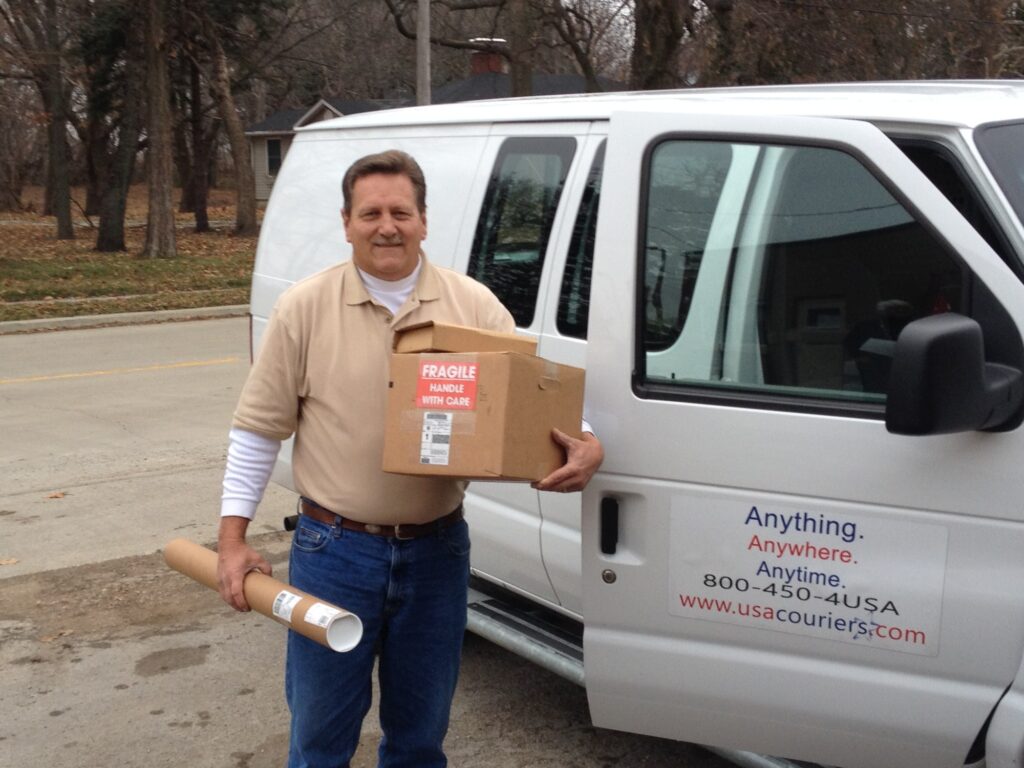
For the last couple of years, especially since Amazon started the retail to consumer race, I have noticed a change in what companies are looking for in a delivery service. What they say they want and what they decide are two very different conversations.

What they say:

Couriers are to make a fair living wage. They even require it in the RFP.

Service is important.

What they do?

Hire the cheapest company they can.

What is Living Wage? As defined by Wikipedia: “A living wage is the minimum income necessary for a worker to meet their basic needs. Needs are defined to include food, housing, and other essential needs such as clothing. The goal of a living wage is to allow a worker to afford a basic but decent standard of living. Due to the flexible nature of the term “needs”, there is not one universally accepted measure of what a living wage is and as such it varies by location and household type.”

Service is defined by Dictionary.com as: “an act of helpful activity; help; aid”

Why is this important?

Most couriers seriously struggle to make end meet and often must have roommates to help pay for their roof. Very few can afford a family or any small “luxuries” like going to the movies and having popcorn. The companies they work for do one of two things: the charge so little per job that the courier only makes a couple of dollars per delivery or they only pay out a small percentage of the revenue. The couriers only option is to hope they have high enough volume to cover gas and life. Couriers get bitter. “Company A” pays fast and more – the couriers who have been squeezed in the past get happy and provide better service for Company A. USA Couriers has very low turnover rate because we look out for the courier and pay them more. Most couriers drive their own vehicle.  Company C’s couriers have cars in better condition and newer, so there are fewer breakdowns and delays. They represent the client better in more professional clothes.

Glassdoor.com states the average courier makes $30,177.00 and Payscale.com states it at $35,302.00. What these figures fail to mention is how much of that money is spent on fuel or wear and tear on their automobiles. Let’s say they drive 80,000 miles per year, according to dollartimes.com, would be $7,857.00 in gasoline. So really, that payscale.com courier is only making $22,320.00. In many cities that would mean you need roommates and a very tight budget. Using AAA’s calculations, there is roughly $18,000+ wear and tear on the vehicle. It’s a downward spiral for the pocketbook. Blood Money.

Being a courier is a choice – a decision to be able to work flexible hours, work outside an office and still meet new people every day while earning money. Many couriers do not have degrees or specialized/trade education. Others may be retired and need the extra money.

Being a courier shouldn’t mean you live in poverty.

USA Couriers provides couriers with additional training which allows them to carry medical specimens or hazardous biological substances. Plus, TSA, HIPAA, Security and Information Awareness, 6.2 packaging and Defensive Driving training. Other companies offer bits and pieces, some more than others. Couriers should be compensated for their knowledge and abilities.

So now you know more than you expected about courier pay you can see how it affects service. The courier is your face (and mine) when he/she delivers your package. Don’t you want a happy professional who will go the extra mile? Next time you are considering hiring a courier service keep this is mind. The difference in cost isn’t so much, but it’s worth it’s weight in gold.

Your Company Drivers vs. Couriers

Artificial Knees and Drivers

Two “events” occurred nearly simultaneously recently. First, I had my knee replaced – keeping me mostly unavailable for a few months. When I returned I learned that a client was under pressure by new management to reduce his operational costs – purchasing three vehicles and currently trying to hire drivers, in other words, bringing the courier service inside the company. After feeling very guilty for being out of reach for so long, came the realization that these two seemingly different events were very much the same.

Just like when my cane took weight and stress off my knee pre-surgery, he had, prior to coming to us ten years ago, used internal employees to complete the daily route. Everything seemed great. One day I fell and one day one of his employees had an accident.

TrafficSafety.org provides these facts:

10 FACTS EMPLOYERS MUST KNOW

For any organization with employees on the roadway

  1. In 2005, 43,443 people were killed and 2,699,000 were injured in 6,159,000 police-reported motor vehicle crashes. Daily that represents 17,000 reported crashes and 119 deaths.
  2. Motor vehicle crashes are the leading cause of death for all age groups from 3 to 33 years of age. Crashes are the 3rd leading cause of years of potential life lost for all ages combined.
  3. Motor vehicle crashes are the leading cause of occupational fatalities in the U.S.
  4. A typical driver in the U.S. travels 12,000 to 15,000 miles annually and has a one in 15 chance of being involved in a motor vehicle collision each year. With most fleet drivers traveling 20,000 to 25,000 miles or more each year, they have a greater crash exposure.
  5. The most dangerous part of the day for any employee is the time they spend in their vehicle with a crash occurring every 5 seconds, property damage occurring every 7 seconds, an injury occurring every 10 seconds, and a motor vehicle fatality occurring every 12 minutes.
  6. Forty-one percent of the average vehicle miles traveled per household are from commuting to and from work (27%) and driving on work-related business (14%).
  7. In 2000, the economic cost of crashes to employers was $60 billion resulting in 3 million lost workdays. Two thirds of the cost ($40 billion) was from on-the-job crashes while one-third ($20 billion) was from off-the-job crashes for employees and their benefit-eligible dependents.

The average on the job crash costs an employer about $16,500 or just under $0.16 per mile driven. Crashes involving injuries cost substantially more — $504,408 for a fatal injury and $73,750 for a nonfatal injury.

http://www.nhtsa.gov/people/injury/airbags/economicburden/pages/WhatDoTCCost.html breaks it down even further and State by State.

So I had my operation, am completely delighted with my new knee, and frankly, my client was delighted to not have the employee as driver burden. Since that time his company has changed ownership 3 times. The new organization is going to save $102.00 per week. One accident will cost them the 161 weeks work of savings (that is without an injury)!

Over the years many companies have come to us after an employee was in an accident while picking up the mail from the Post Office, the constant damage to the vehicles was at the point of not worth repairing them any longer, loss of productive working hours of employee, etc. There have been many reasons, the most tragic being a death.

How does this affect your workplace? Are you gambling with employees by having them run company errands? The client’s new management sure is. Two if the drivers will be driving long distances on mountain roads every day.

An ounce of prevention is worth a pound of cure.

Ancient proverb

So, 5 reasons to use a courier…

  1. Courier companies have insurance to cover accidents, and the resources to replace drivers when something does happen (illness, emergency and more). Drivers have safety classes and are carefully screened.
  2. Your company is protected from a variety of claims: from insurance fraud to wrongful death.
  3. Our number one direct cost is fuel – so the higher the MPG figures our vehicles achieve, the less fuel we have to buy with the obvious environmental benefits this achieves – this is done by matching the load to the vehicle – you don’t use a transit van to deliver a confidential folder that can far more efficiently be delivered on a motorcycle or scooter, and by regular maintenance to help vehicles burn fuel optimally and updating of the fleet – we have recently started using an LPG powered van which produces 33% less CO2. We use van substitutes as often as possible (Kia Soul and Nissan Cubes).
  4. The quicker we get from our departure point to our destination, the more work we can achieve from a driver and the vehicle in a day – but this is not achieved by a the vehicles driving faster as this is less fuel efficient and more dangerous for other road users and pedestrians, it is achieved by accurate routing, avoiding congestion which is the number one enemy of the courier driver – this is made possible by using the latest navigation equipment that is able to update traffic information every two minutes providing the quickest route to the destination even though this may not be the shortest route in absolute distance.
  5. Couriers are far more flexible. They don’t raid petty cash for gas money, nor take extra long lunch breaks because they are out running company errands. There are enough couriers that we aren’t hampered by childcare or a game of golf/basketball/etc.